
> Cuba > Havana
Overview
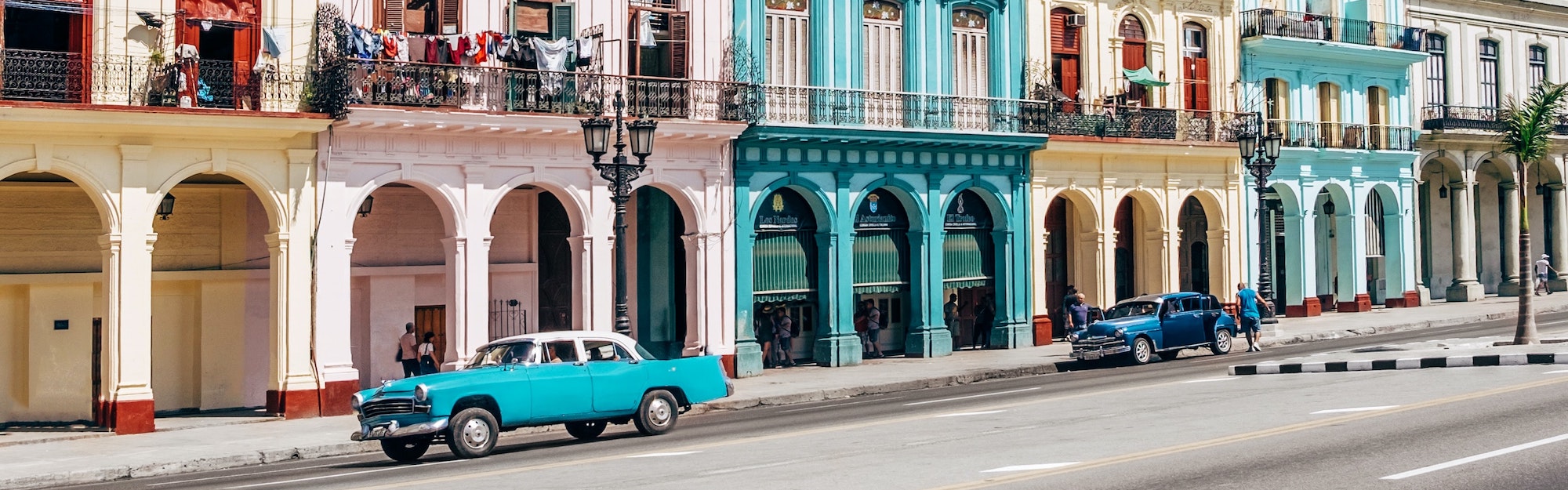
Situated on the north coast of the island and built around a natural harbour, Havana is one of the most lively and colourful cities in the Caribbean. Much of the city's charm can be found among the narrow, derelict streets packed with old buildings and fascinating characters. Every open door and overhanging balcony provides glimpses of rocking chairs and colourful washing, accompanied by strains of music.
Old Havana (Habana Vieja) is a UNESCO World Heritage Site and a major tourist destination. The Spanish left behind some exquisite colonial architecture, and many of the great buildings and grand plazas are being restored to their former glory, although ironically the general dilapidation of the great buildings of Havana contributes enormously to their charm.
Central Havana (Centro Habana) has some of the most important museums and architectural highlights of the city, including the Revolution Museum and the National Capitol, which resembles the US Capitol Building in Washington DC. The trendy suburb of Vedado boasts high-rise buildings and draws both locals and tourists with its theatres, art galleries, restaurants, cafes and cabaret shows. The five-mile (8km) pier, or malecon, stretches from Vedado to Habana Vieja, and is lined with architectural gems in various states of disrepair or restoration.
Havana's nightlife has the potential to challenge even the most seasoned partygoer. After dark, clubs and bars come alive and the famous rum cocktails flow freely. Travellers looking for a break from the revelry will find lovely beaches only twenty minutes east of the city.
Climate
The Cuban climate is tropical and temperate with cool trade winds to provide relief from the heat and humidity. Havana's weather is typical for Cuba; it is generally sunny and hot year round apart from when it is stormy, which is why it is considered a year-round tourist destination. There is not much variation between day and night temperatures along the coast, and average sea temperatures are 77F (25C). The rainy season, from May to October, is also the hurricane season, but most hurricanes strike between August and October, while the wettest months in Havana are May and June. Hurricanes are usually more of a problem on the south coast of Cuba and Havana is typically safe from the worst of the tropical storms. Summer temperatures average around 81F (27C) with humidity at about 80 percent. Temperatures of about 68F (20C) are normal in winter. The temperature very seldom drops below 50F (10C) in Havana. The most popular time to visit Havana is in the winter months of December and January but, although avoiding the hurricane season is probably wise, Havana's weather is pleasant for travellers all year.
| Jan | Feb | Mar | Apr | May | Jun | Jul | Aug | Sep | Oct | Nov | Dec | |
|---|---|---|---|---|---|---|---|---|---|---|---|---|
| Rain (cm) | 64 | 69 | 46 | 53 | 99 | 183 | 107 | 99 | 145 | 180 | 89 | 58 |
| Rain (inches) | 2.8 | 1.8 | 1.8 | 1.3 | 4.7 | 6.5 | 4.9 | 5.3 | 5.9 | 6.8 | 3.1 | 2.3 |
| Average Temperature (°C) | 19 | 21 | 21.5 | 22.5 | 24.5 | 26 | 26 | 26.5 | 25.5 | 24 | 22.5 | 20.5 |
| Min Temperature (°C) | 14 | 16 | 16 | 17 | 20 | 22 | 22 | 22 | 22 | 20 | 18 | 16 |
| Max Temperature (°C) | 24 | 26 | 27 | 28 | 29 | 30 | 30 | 31 | 29 | 28 | 27 | 25 |
| Average Temperature (°F) | 68.5 | 69 | 70.5 | 73 | 76.5 | 78.5 | 78.5 | 79 | 78 | 75.5 | 72 | 69 |
| Min Temperature (°F) | 58 | 60 | 61 | 63 | 68 | 71 | 71 | 71 | 71 | 68 | 64 | 61 |
| Max Temperature (°F) | 79 | 78 | 80 | 83 | 85 | 86 | 86 | 87 | 85 | 83 | 80 | 77 |
Getting Around
Cubans rely heavily on an unreliable bus system that is cheap but overcrowded and slow, with long queues and inconsistent routes and schedules. The new modern city buses travel to anywhere in the city. Most visitors to Havana avoid the buses and rely instead on the numerous, inexpensive taxis to get around the greater part of the city.
Renting a car is not the best option as car hire is expensive, road signs are poor and numerous one-way streets make driving a real challenge. Different types of taxis cruise the streets, including tourist taxis, two-seater bicycle taxis and the iconic and not totally safe yellow scooter coconut taxis. Most tourist taxis are air conditioned, metered, well maintained and charge in convertible pesos.
There are also vintage car owners who operate as unofficial taxis, although a rate should be negotiated beforehand as passengers are likely to be overcharged. A couple of vintage cars can be hired by tourists for tours around the city too, and can be found outside main tourist attractions such as the Revolution Museum or the Capitolio. It is not generally difficult or expensive to get around in Havana, and it is a wonderful walking city when it comes to shorter distances.
Nightlife
The nightlife scene in Havana pulses with Latin rhythms, sultry dancing and timbale drum beats. Live music is highly popular in Havana, and visitors can enjoy the unique experience of partying it up to jazz, samba and salsa in local clubs and bars, although there are also some more conventional clubs with the standard DJ on the decks.
In general, Cubans love to look chic and stylish so tourists shouldn't be afraid to dress up when hitting the streets for a night on the town. Travellers should head to La Bodeguita del Medio in Old Havana, which is very touristy but a great place to get warmed up to the local flavour, before hitting nearby clubs where local musicians jam, while rum keeps spirits high.
El Chevere, in Parque Almendares, is a gigantic open-air club that keeps the music going all night long with pop, hip-hop and salsa beats, while the Havana Café in the Hotel Melía Cohiba in Paseo is the place to see and be seen. For memorable performances, venues such as La Tropical in Playa feature live bands, while Jazz Cafe and Jazz Club La Zorra y el Cuervo in Vedado are two of Havana's top live jazz venues. Clubs don't get busy until after 10pm, and often stay open all night long.
Havana has a thriving arts community, with internationally renowned groups such as the Cuban National Ballet performing in the Gran Teatro de La Habana or the national symphony orchestra in the Teatro Amadeo Roldan. The Sabado de la Rumba occurs every Saturday afternoon at El Gran Palenque, and is a charismatic mix of secular and Afro-Cuban religious dancing and drumming. Although locals are generally friendly and welcoming, crime is a problem and travellers should exercise caution getting around at night and be on the alert for scams.
Sightseeing & Attractions
Sightseeing
Havana's varied architecture is its best feature, and sightseers will encounter a fascinating history that speaks through everything from museums and churches to colonial forts and elaborate city squares. With its friendly residents juxtaposed by elegantly dilapidated buildings and occasionally derelict streets, there's nothing quite like Cuba's capital.
Just breathing in the scents and watching the vintage cars roll down the streets make for a great day out. However, heading into the historic old town of La Habana Vieja is a must, with the UNESCO World Heritage Site and its magnificent colonial buildings ripe for exploration. Tourists can take in the sights and sounds as they stroll down the Calle Obispo, a pedestrian boulevard that meanders through the streets, past the Parque Central and to some of the more hidden gems of Old Havana. The best view of the city is from the Camera Obscura, which provides a 360-degree look from atop the Plaza Vieja, while travellers are encouraged to take a stroll along the pretty pier.
It's worth visiting the cigar factories and rum distilleries to sample some world-famous Cuban exports, and to stroll through the Plaza de la Revolucion to imagine the historic speeches of political figures such as Fidel Castro and Che Guevara. The Museo de la Revolucion is also a major stop for history buffs. Fans of Ernest Hemingway can visit the museum dedicated to him on the outskirts of town. Set in his lovely old residence, it's where he wrote a few of his best books.
Havana is special for visitors simply because it feels so authentic, with a distinct character and little of the tacky tourist developments that overrun many other Caribbean destinations. After a long day of sightseeing in the city, travellers can head to the nearby beaches, most of which are located no more than 20 minutes away, to soak up some Caribbean sun and sip on a rum cocktail.
Kids Attractions
There are many fun places for children in Havana, both educational and recreational. The Acuario Nacional has dolphin and seal shows, while the Camera Obscura will give them a great look at the city through its telescopic lens. The Isla del Coco amusement park, located in Playa, is the largest in Havana and good fun for the whole family.
There are a few parks in Old Havana with play areas for children. Some have entry fees, but these are usually in Cuban Pesos and amount to a few cents. Lenin Park is enormous and has everything from swimming pools and horseback riding to a zoo and an amusement park. Parque La Maestranza in Old Havana is less extensive, but has play areas, pony rides and a train ride.
There are also plenty of stunning wilderness areas close to Havana, such as the Montemar Natural Park, which make for good family excursions and day trips. Kids seem to particularly love the crocodile farm at Montemar.
Havana is a colourful, laid-back and friendly city, which makes it a good destination for families travelling with kids. Just walking around the bustling streets and strolling along the promenade make for fun family days out. And, of course, the beaches will delight everyone.